
Google Business Profile Optimization Guide (2026)
Follow this step-by-step Google Business Profile optimization guide to rank higher in local search, get more calls, and show up in AI-powered local results.
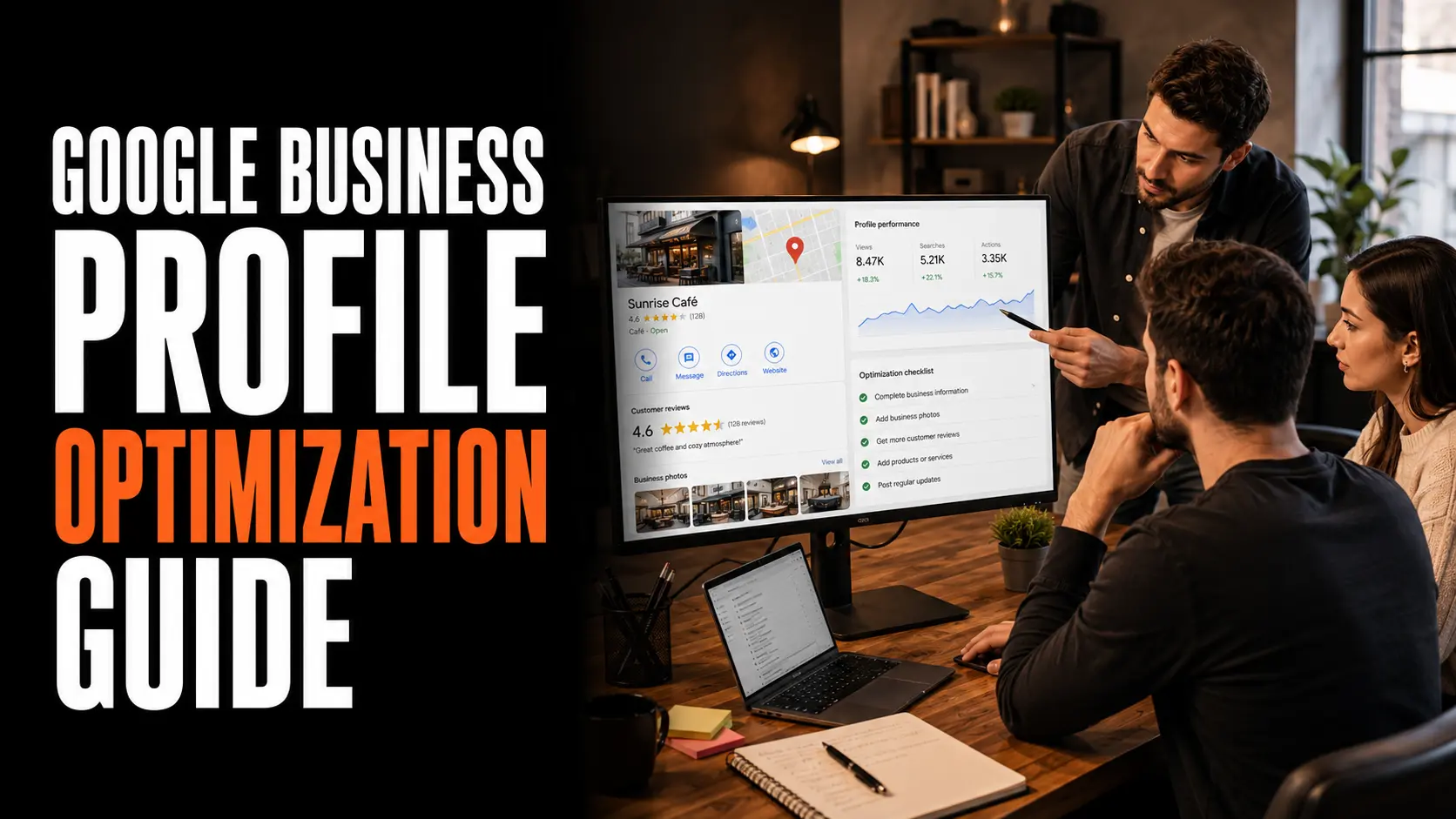
Your Google Business Profile is the most powerful free tool Google gives local businesses. Get it right, and it puts you in the Local Pack, drives calls directly from search, and gets your business cited in AI-generated local answers. Get it wrong, and no amount of website SEO will save you.
We manage Google Business Profile optimization for hundreds of local businesses across all 50 US states at SEO Service USA. Plumbers in Chicago, roofers in Dallas, dental offices in Miami. We've run this process across every competitive local market in the country.
This guide covers every step of the process, every 2026 ranking signal that matters, and the exact moves that separate businesses in position one from businesses that never show up at all.
Written by Likhon Ahmed
CEO & Local SEO Strategist, SEO Service USA | Queens Village, New York City
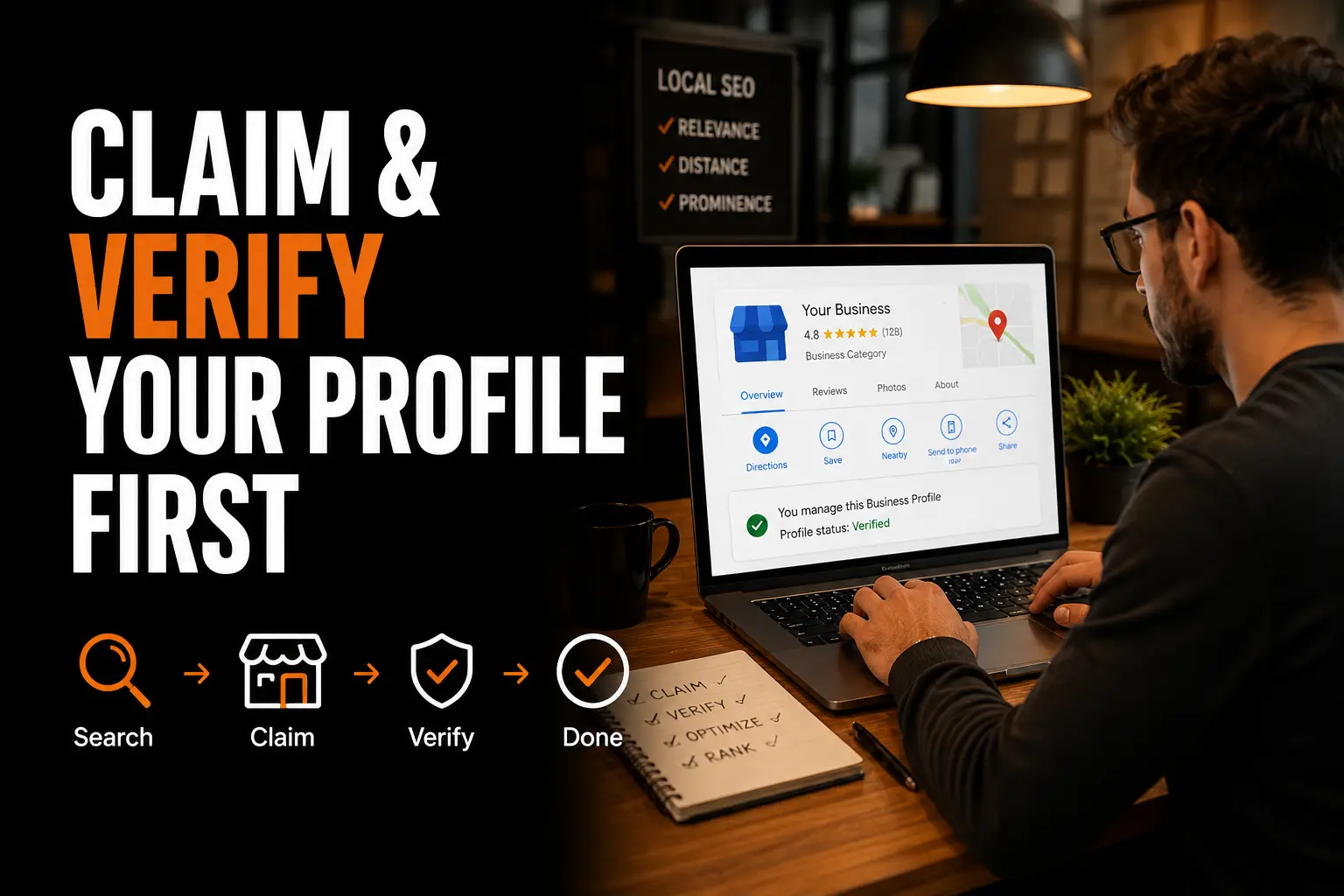
Step 1: Claim and Verify Your Profile First
No optimization matters until your profile is verified. Google only surfaces verified listings in the Local Pack and on Google Maps.
Go to business.google.com, search your business name, and claim it. If a listing already exists, created by a previous employee or auto-generated by Google, use the "Own this business?" link to claim it. Submit your verification request via postcard, phone, email, or video recording depending on the options Google shows you.
One non-negotiable rule applies here: your business name on GBP must match your real-world legal name exactly. No added service keywords. No location modifiers. No keyword padding in the name field. Google treats keyword-stuffed names as spam and suspends listings that use them. We've seen this happen to businesses that thought they were being clever. It is not worth it.
Complete the verification process fully before touching anything else.
Step 2: Pick the Right Primary Category. This Is Your #1 Ranking Signal
The Whitespark 2026 Local Search Ranking Factors survey, based on input from 47 leading local SEO experts, ranked the primary GBP category as the single most influential factor for Local Pack visibility.
Choose the category that most precisely describes your core business. A plumbing company selects "Plumber", not "Home Services" or "Contractor." The more specific the match, the stronger the relevance signal for high-intent queries.
Google allows up to 9 additional categories. Research shows businesses that use 4 additional categories average a map ranking position of 5.9, which is measurably better than those using none. Each additional category expands the range of queries your profile matches.
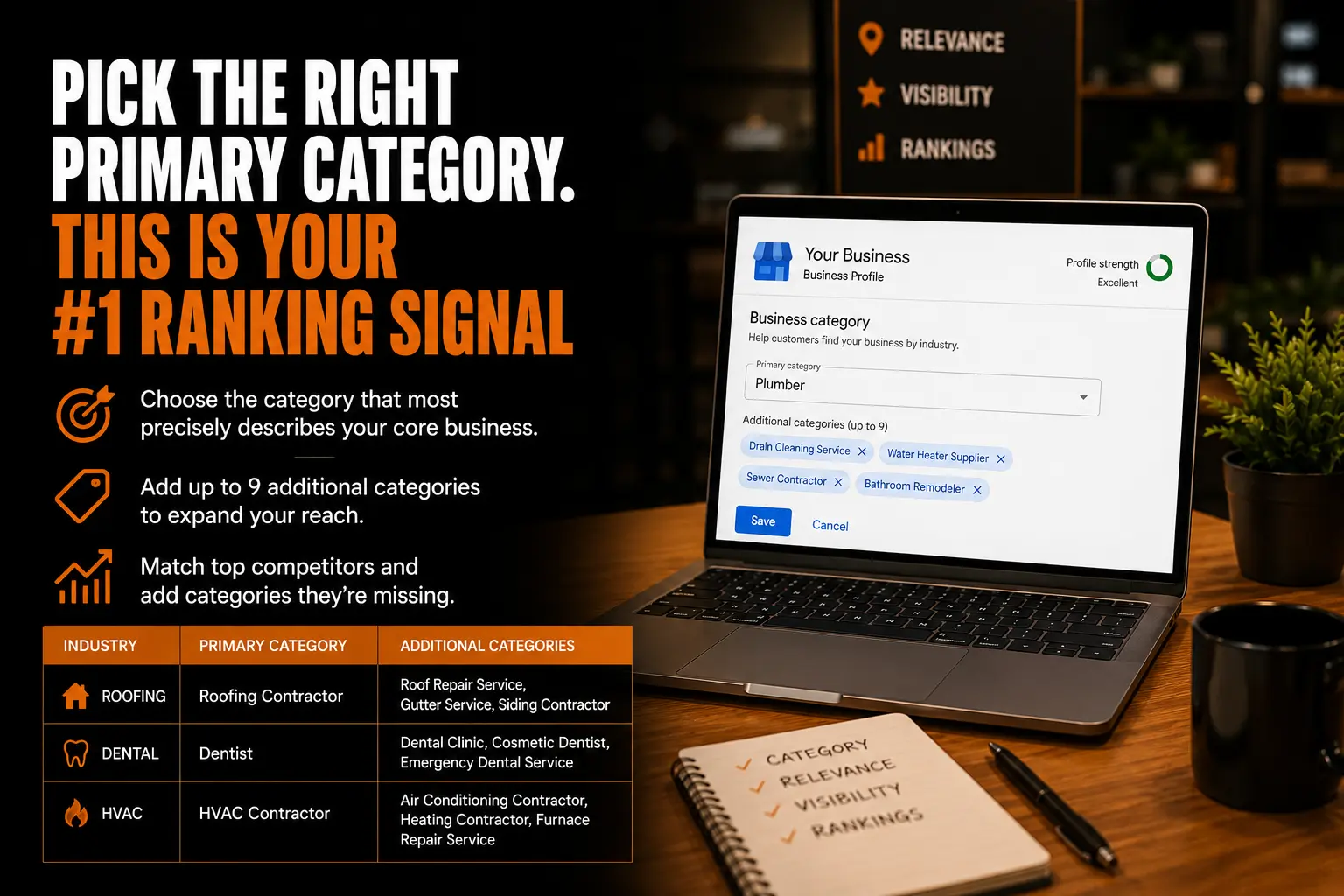
Here is how we typically structure this for three common industries we work with:
| Industry | Primary Category | Additional Categories |
|---|---|---|
| Roofing | Roofing Contractor | Roof Repair Service, Gutter Service, Siding Contractor |
| Dental | Dentist | Dental Clinic, Cosmetic Dentist, Emergency Dental Service |
| HVAC | HVAC Contractor | Air Conditioning Contractor, Heating Contractor, Furnace Repair Service |
Pull up your top three competitors in Google Maps and check their category selections. Match what is working in your specific market, then add categories they are missing.
Step 3: Complete Every Section of Your Profile. No Gaps.
A complete profile consistently outranks an incomplete one. Google rewards completeness because it reduces uncertainty for the algorithm and gives users accurate information. Incomplete profiles send a different signal: this business may not be credible.
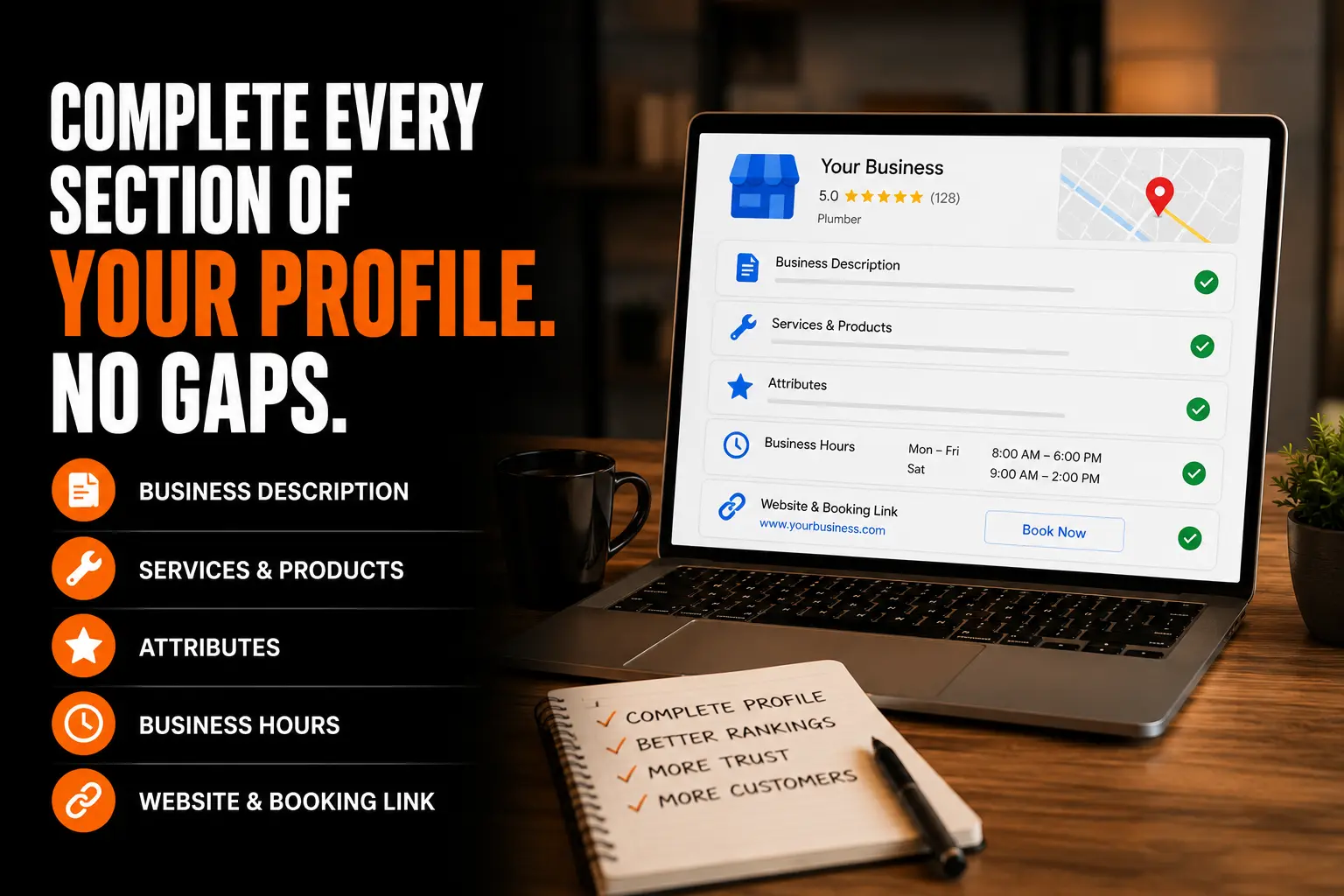
Business Description
Keep your description clear and natural. Cover your primary service, your location, and one specific differentiator. Include your main keyword once, placed where it reads naturally. Do not list services in a comma-separated block. Google's natural language processing models read that as keyword spam, not useful content.
Services and Products
Add every service individually with its own description. Each entry is a separate relevance signal Google uses to match your profile against specific search queries. One entry for "Plumbing" is weak. Separate entries for "Emergency Leak Repair," "Water Heater Installation," "Drain Cleaning," and "Sewer Line Inspection" are far stronger.
Attributes
Attributes answer specific questions users ask, and they feed Google's conversational search directly. Gemini now pulls from GBP attribute fields to answer multi-condition queries: "plumber in Denver open now with financing available." Fill every applicable attribute. Moz's 2026 local SEO research confirmed attribute completeness is one of the fastest-growing ranking factors for AI-driven and conversational local search.
Business Hours
Your hours are an active ranking signal in 2026, not just informational text. The Whitespark 2026 report confirmed that being listed as open when a user searches is the 5th most influential factor for Local Pack rankings. A BrightLocal tracking study found ranking positions dropped consistently when businesses showed as closed during search windows. Set accurate regular hours, add holiday hours before major holidays, and review them quarterly.
Website URL and Booking Link
Link to the landing page that matches the search intent behind the query, not your homepage. A user searching "emergency plumber near me" who clicks your GBP listing should land on your emergency plumbing page. The gap between your homepage and the right service page costs conversions every day. If your business takes appointments, connect a booking link directly through GBP using Calendly, Booksy, or any supported platform. Fewer steps to booking means more bookings.
Step 4: Upload Real Photos, Then Keep Adding More
Photo engagement is a behavioral signal. Profiles with active, authentic visual content outperform those without in both ranking and click-through rate.

Visuals Build Trust
Google's AI models can detect generic stock photography. Use real images.
Upload real photos from your actual business:
- Exterior shot of your location or vehicle
- Interior photos of your office, shop, or workspace
- Team and staff photos: builds trust and signals real people run the business
- In-progress and completed job photos, essential for every service business
- Equipment photos, which reinforce legitimacy and scale
Post new photos regularly. Frequency sends a freshness signal. A roofing company posting before-and-after job photos twice a week tells Google this profile is actively managed. That activity translates directly into ranking stability.
Videos work the same way. A 30-second walk-through of your shop or a quick explanation of your process adds depth to your listing and increases time-on-profile. Keep videos short, real, and specific to your business.
Never upload stock photos. Google identifies generic imagery and it builds zero trust with prospective customers who are evaluating whether to call you.
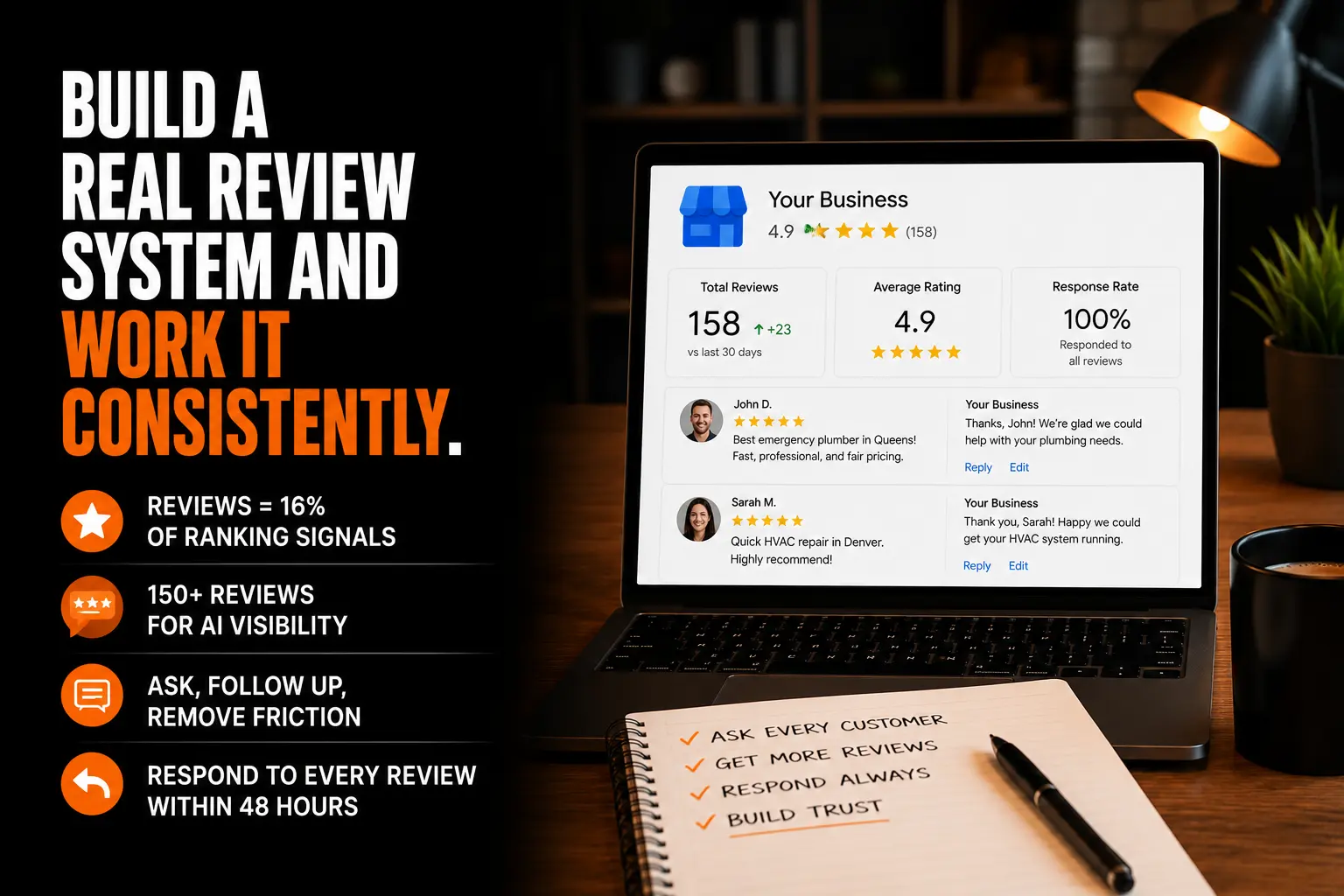
Step 5: Build a Real Review System and Work It Consistently
Review signals carry 16% of the total local ranking weight in the 2026 signal breakdown. Beyond traditional ranking, there is a measurable threshold for AI citation: your business needs at least 150 reviews per location before ChatGPT, Perplexity, and Gemini regularly name you in local AI-generated recommendations.
That number is important. It is a line between traditional local search visibility and AI-powered local visibility. Businesses below that threshold largely disappear from conversational AI results.
Getting reviews the right way
Ask at the close of every completed job or service interaction. Text a direct Google review link immediately afterward. Remove every point of friction. Never offer incentives in exchange for reviews. Google removes incentivized reviews and may suspend your listing.
Train your team to make the request natural. A simple, honest ask at the right moment produces far more reviews than any automated follow-up sequence.
Responding to every review
Responding to reviews is no longer optional. Google registers response rate as an engagement signal. More importantly, reviews that organically mention specific services and locations, such as "best emergency plumber in Queens" or "fastest HVAC repair in Denver", provide keyword and entity signals that Google weighs directly in ranking.
Respond to every review within 48 hours. Acknowledge the specific service the customer mentioned. Thank them by name. Add one natural keyword reference where it fits. Keep the tone human, not templated.
Handling negative reviews
Respond professionally, acknowledge the issue, and move the resolution offline. Arguing publicly harms your profile more than the negative review itself. A well-handled negative review, responded to calmly and constructively, often builds more trust than a clean five-star string with no responses.
Step 6: Post to Your Profile Every Week
Google Posts appear directly in your search listing and signal to Google that your business is actively maintained. Active profiles rank better than stale ones. The algorithm treats post frequency as a freshness indicator.
Post at minimum once per week. Use posts for:
- Seasonal service promotions and offers
- Completed job highlights with photos
- Local events your business supports or sponsors
- New service announcements
- Practical tips relevant to your industry
Every post supports a call-to-action button: "Call Now," "Book Online," "Learn More," or "Get Offer." Always use it. A post without a CTA is a missed conversion. The goal is not content marketing. It is active signal management combined with direct lead generation.
Posts expire after seven days unless pinned. Set a weekly reminder and treat this like a business habit, not a marketing project.
Step 7: Take Control of Your Q&A Section
The Q&A section on your GBP is publicly editable. Anyone can ask a question, and anyone can answer it. An unmanaged Q&A section is a liability because third-party answers are often inaccurate, and inaccurate information in your listing directly damages trust and rankings.
Log in weekly and answer every question promptly before someone else provides a wrong answer. Use your responses to include relevant keyword context in a natural way.
Seed the Q&A section yourself with the questions your customers ask most frequently. Ask a team member or trusted contact to post the question from their account, then post the authoritative answer from your business profile. Start with 5 to 10 well-chosen questions. Pre-populated Q&A removes ambiguity for both users and Google's entity matching systems.
Step 8: Lock Down NAP Consistency Across Every Directory
NAP, which stands for Name, Address, Phone, must be identical across every platform where your business appears: Yelp, Bing Places, Apple Maps, Facebook, industry-specific directories, and your own website.
A single variation creates what the local SEO industry calls entity fragmentation. Google's local ranking model loses confidence in your business data when the signals conflict. Local Pack visibility drops as a direct result of that lost confidence.
"Ave" versus "Avenue." "Suite 4" versus "Ste. 4." These small inconsistencies read as two different businesses to Google's entity resolution system. Audit your citations every six months. Fix every discrepancy. Your GBP name, address format, and phone number must match your website's structured data exactly.
Step 9: Connect Your GBP to Your Website with LocalBusiness Schema
Your website must reinforce your GBP, not just link to it. Add LocalBusiness JSON-LD schema markup to your homepage and location pages. Include your NAP, service area, business hours, and geo-coordinates. For a deeper dive into on-page setup, check our full local SEO guide.
Schema markup lowers Google's cost of retrieving and processing your entity data. It makes your business information machine-readable, which directly strengthens your entity grounding in Google's Knowledge Graph. Strong Knowledge Graph presence increases the probability of appearing in AI-generated local answers.
Embed a Google Map on your contact page. Keep your NAP visible in the footer of every page on your site. Build individual location pages for every city or neighborhood you serve, and link each page back to the primary GBP listing.
When your website and your GBP tell the same story with the same data, Google treats your business as a verified, trustworthy entity. That trust directly supports Local Pack and AI search visibility.
Step 10: Read Your GBP Insights Monthly and Act on Them
GBP Insights shows you exactly how customers find and interact with your listing. Most business owners never look at this data. That is a significant competitive advantage left on the table.
Track these four metrics monthly:
Search queries
Which keywords triggered your profile appearance.
Profile views
How many people saw you in Search vs. Maps.
Calls & direction requests
Your actual conversion rate from profile views.
Website clicks
Traffic volume flowing from GBP to your site.
If direction requests are high but calls are low, your phone number or CTA needs attention. If profile views are strong but actions are low, your photos or reviews are not converting viewers into callers. The data tells you exactly what to fix.
Add UTM parameters to your website link in GBP. Without them, your analytics platform misattributes GBP traffic to direct or organic. You need to know which traffic and which leads are coming from your profile.
GBP Optimization and AI Search in 2026
Google's AI Mode now pulls from the same GBP engagement signals it uses for traditional Local Pack rankings. Review recency and sentiment, photo freshness, post activity, accurate hours, and service completeness all feed AI-generated local answers alongside traditional map results.
The Whitespark 2026 Local Search Ranking Factors report introduced a new AI Search Visibility category for the first time. Citation-based and entity-based signals account for three of the top five AI visibility factors identified in that report.
Businesses with consistently updated, actively managed profiles appear in AI-driven local answers. Businesses with stale, incomplete profiles do not. There is no separate optimization track for AI search. The same steps that improve traditional Local Pack ranking improve AI citation probability. Execute them consistently and both channels grow together.
8 Common GBP Mistakes That Kill Local Rankings
We audit dozens of local business profiles every month at SEO Service USA. The same mistakes appear repeatedly, and every one of them is preventable.
Keyword stuffing the business name
Adding "Best Plumber NYC" to your GBP name field violates Google's guidelines. Your listing gets suppressed or suspended. Use your actual legal business name.
Inconsistent NAP across directories
Small format differences trigger entity fragmentation. Google stops trusting your data. Audit and standardize everything across every platform.
Wrong or missing hours
If your listing shows as closed when you are actually open, you lose ranking visibility during peak search moments. Update hours quarterly and set special holiday hours in advance.
Zero review responses
Unresponded reviews signal disengagement to both Google and prospective customers. Respond to every review within 48 hours, positive and negative.
Static photo library that never grows
A profile with 10 photos from 2022 ranks below one that adds new photos weekly. Photo freshness is a ranking signal. Keep it moving.
Homepage-only website link
Sending all GBP traffic to your homepage loses conversion intent on service-specific queries. Send users to the page that matches what they searched.
Unmanaged Q&A section
An unanswered or third-party-answered Q&A actively damages trust and provides inaccurate signals to Google. Monitor it weekly.
No UTM parameters on the website link
Without UTM tags, you cannot attribute conversions to your GBP. You lose visibility into one of your highest-performing lead sources.
Frequently Asked Questions
How long does GBP optimization take to improve local rankings?
Most businesses see measurable ranking improvements within 4 to 8 weeks of completing full profile optimization: accurate categories, complete services, consistent NAP, and active review collection. Competitive markets and newer listings may take 3 to 6 months to build enough prominence signals to move significantly.
How many Google reviews does a business need to rank in the Local Pack?
No fixed review count guarantees Local Pack placement. Google weighs review velocity, recency, response rate, and content quality alongside total volume. That said, the 2026 AI citation threshold sits at approximately 150 reviews per location. Below that number, AI-powered local answers from ChatGPT, Perplexity, and Gemini rarely name your business specifically.
Does a business website affect Google Business Profile rankings?
Yes, directly. Consistent NAP on your website, LocalBusiness schema markup, location-specific service pages, and an embedded Google Map all strengthen GBP prominence in the local algorithm. A strong website amplifies a strong profile. A weak website can drag down a well-optimized profile.
Do Google Posts improve Local Pack rankings?
Google Posts are not a direct ranking factor on their own. They contribute to profile freshness signals and engagement metrics, both of which indirectly support Local Pack position. More practically, consistent posting demonstrates to Google's algorithm that your profile is actively managed, which strengthens the overall profile authority signal.
Can a newer business compete with established businesses in the Local Pack?
Yes. A newer business with a complete profile, strong review velocity from day one, active weekly engagement, and consistent NAP across directories can outrank older businesses with neglected listings, particularly in mid-level competitive queries. Profile quality matters far more than listing age once a business builds enough prominence signals.
Is Google Business Profile the same thing as Google My Business?
Google rebranded Google My Business to Google Business Profile in November 2021. They are the same platform. If you encounter content referencing Google My Business optimization, the core principles apply to the current Google Business Profile, though certain features and interface details have changed since the rebrand.